How Much Should You Budget for a Full-Mouth Restoration?
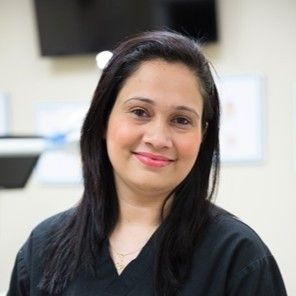
Dr. Deepika Verma
Dr. Deepika Verma is a dentist serving the DFW, TX community. A graduate of New York University with a residency at New York Hospital Queens, she is a member of the American Dental Association and is passionate about patient-first, lifelong dental health.
Connect with Dr. Deepika Verma
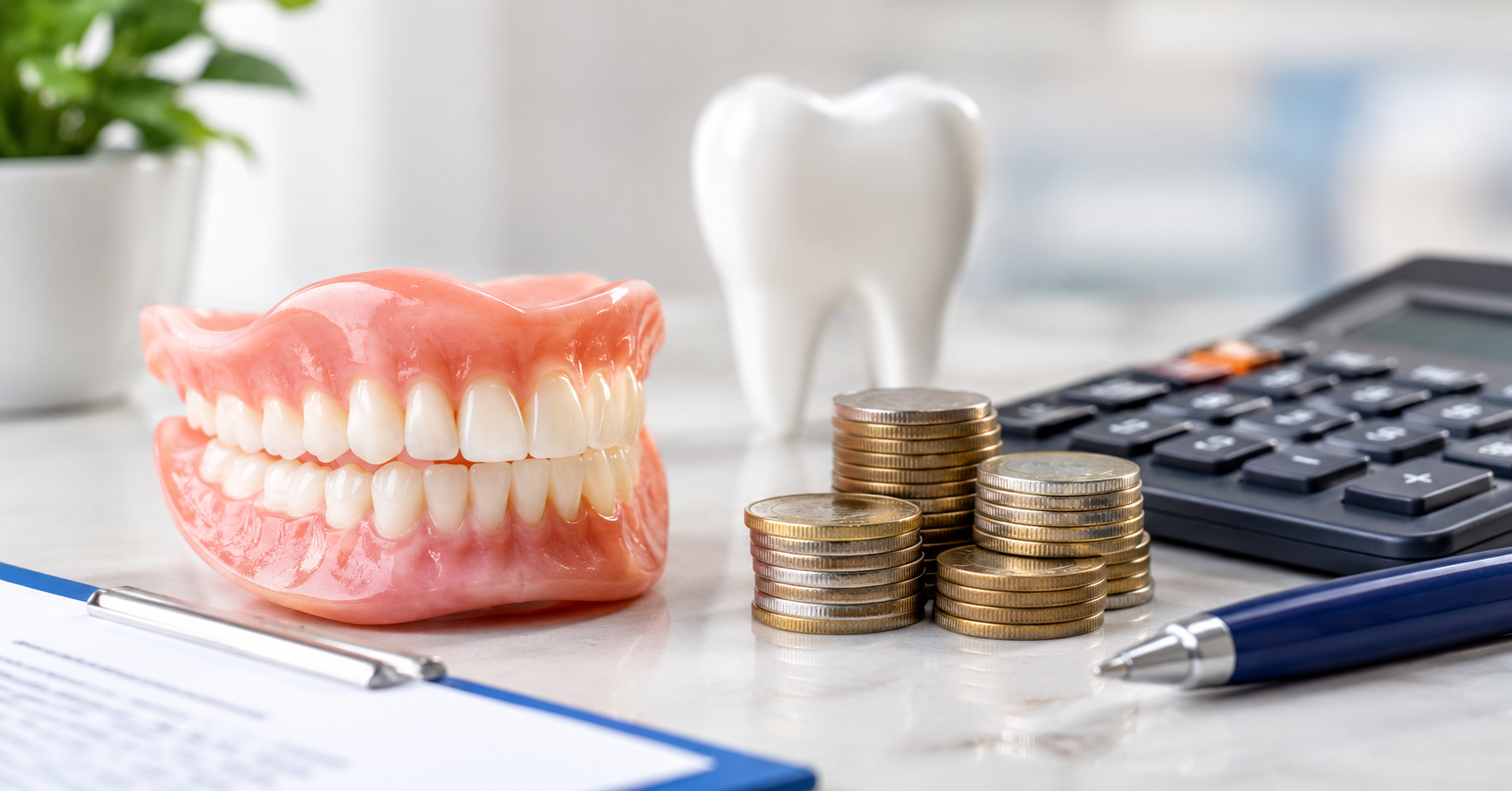
Budget about $30,000 to $35,000 for a typical fixed full-mouth implant case in 2026, with independent dentists charging $23,284 to $55,010 for both arches, according to Real Dental Costs' pricing data reviewed September 2, 2026. Add $3,000 to $10,000 if teeth still need removing, and $5,000 to $13,000 per arch if you choose a zirconia bridge over acrylic.
Those figures cover the implants, the surgery, and the fixed bridge. What most people leave out of their savings target is the work around the surgery, so we walk through each item below with a named source for every number.
At Spark Dental we give you a written, itemized figure after one visit. Call us at (817) 962-7072 or book an implant consultation.
What the Published 2026 Benchmarks Say a Fixed Arch Costs
Three published 2026 benchmarks put a fixed full arch between $11,642 and $30,878, depending on who is quoting and what they bundle. Real Dental Costs' independent-dentist band is $11,642 to $27,505 per arch, with a typical figure of $15,179. Aspen Dental reports a 2026 national average of $19,979 per arch, inside a range of $19,315 to $30,878. Affordable Dentures & Implants advertises fixed teeth from $12,995 per arch on its office pages, per Real Dental Costs' August 2026 crawl.
The chain numbers run higher because they usually bundle the CBCT scan, sedation, and both the temporary and final bridge into one headline price, while an independent office lists those separately. A bundled figure and an itemized one cannot be compared until both are written out the same way.
Both arches at the independent typical price come to about $30,358, our baseline for the rest of this guide. One arch versus two is a real decision: many people lose most of their upper teeth while the lower ones stay serviceable, and a single upper arch is a common, cheaper plan. If you are still weighing a fixed arch against a snap-in denture or a bridge, our guide to what each tooth replacement option costs and how long it lasts
compares them.
The Add-Ons That Turn $30,000 Into $45,000
Extractions, bone grafting, sinus lifts, sedation, and a zirconia upgrade are the five items that push a $30,000 full-mouth case toward $45,000, and most quotes list them outside the headline arch price. The bands below come from the same September 2026 dataset.
| Add-on | Typical U.S. band (2026) | Who usually needs it | What removes it from your plan |
|---|---|---|---|
| Extractions | $75 to $800 per tooth, typical $300 | Anyone with failing teeth still in the arch | Having no natural teeth left |
| Socket preservation graft | $300 to $800 per site | Patients whose implants go in weeks after extractions | Same-day implant placement |
| Ridge augmentation | $800 to $2,000 per arch | Long-term denture wearers whose jaw has narrowed | Guided placement into remaining dense bone |
| Sinus lift (upper arch) | $1,500 to $3,500 per side | Upper jaws with little bone under the sinus | Angling the rear implants forward of the sinus |
| IV sedation | $500 to $1,500 per surgical visit | Most patients having both arches placed in one day | Local anesthesia with oral sedation |
| Zirconia final bridge | Adds $5,000 to $13,000 per arch | Patients who want stain and fracture resistance | Choosing an acrylic hybrid now, upgrading later |
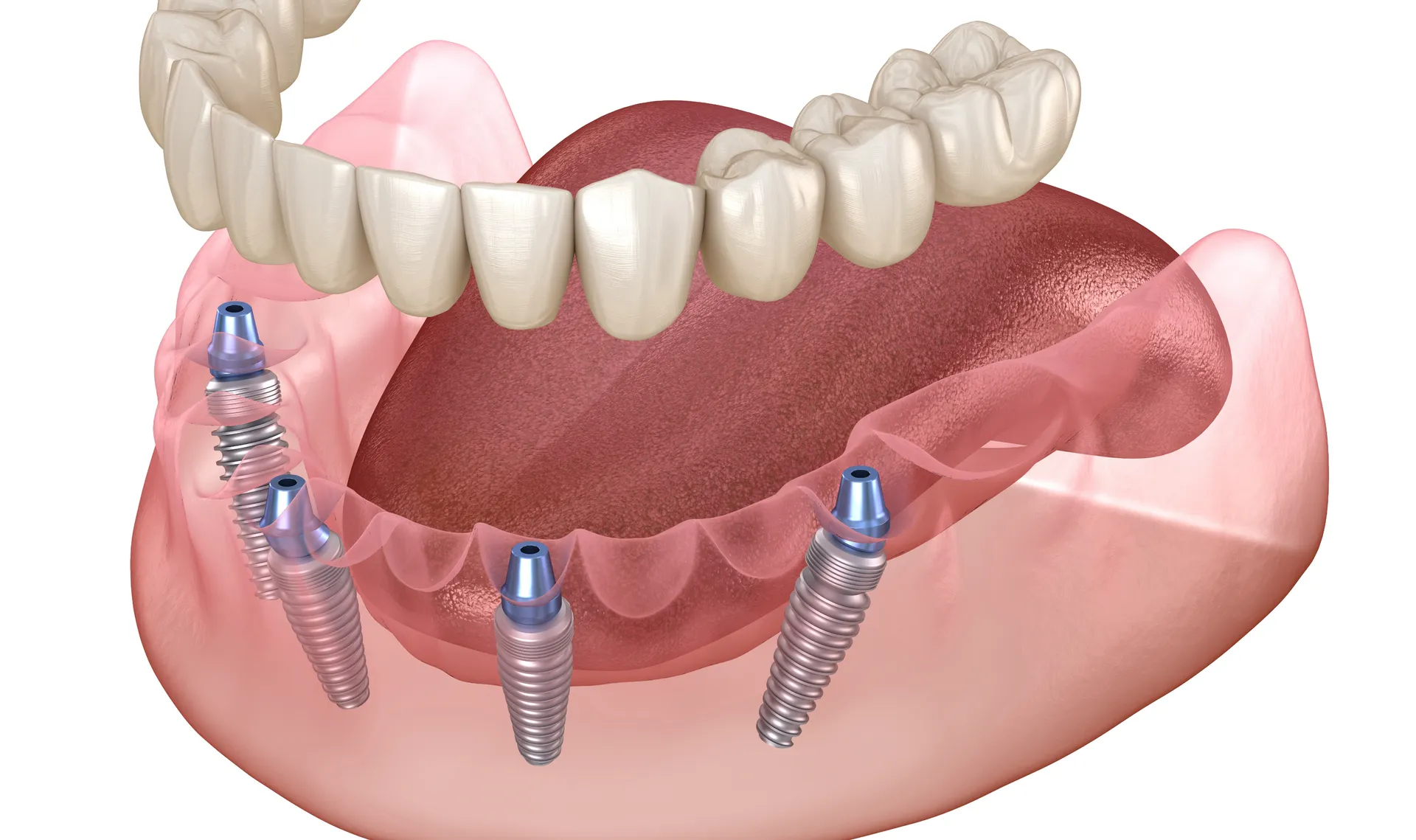
The three bone-related lines are the hardest to predict without imaging, and our planning is built to avoid them. Our All-on-4® full-arch treatment
uses computer-guided surgery to place four implants where your bone is densest, so many long-time denture wearers skip grafting and leave the surgical visit with a temporary fixed arch the same day. When grafting is still needed, we perform bone grafting here, on the same plan.
Acrylic or Zirconia: A Ten-Year View
Zirconia is worth budgeting for if you expect to keep the same bridge for ten years or more; acrylic is the better call if you need the lowest total this year and can accept a rebuild later. The upgrade adds $5,000 to $13,000 per arch, lifting a typical arch to about $23,179.
An acrylic hybrid is resin teeth bonded to a titanium bar. It is what nearly every same-day temporary bridge is made of, it repairs easily if a tooth chips, and it is the cheaper final bridge, though Real Dental Costs' maintenance assumptions have hybrids remade within five to fifteen years. Zirconia is milled from one block of ceramic; it resists staining and fracture and rarely needs remaking inside ten years.
Over a decade, the same dataset models a full acrylic mouth at about $42,358 including one remake, versus about $49,358 for zirconia with routine maintenance only. The ten-year premium for zirconia is therefore closer to $7,000 than the $16,000 separating the two on day one.
Why Insurance Covers Less Than You Expect, and How to Stretch It
Dental insurance usually pays part of the extractions and sometimes part of the final bridge, but almost never the implants, and whatever it pays stops at an annual maximum of about $1,000 to $2,000. In a $30,000 case, that ceiling is what matters.
The CareQuest Institute's February 2026 analysis estimates that around 32 million U.S. adults reached or exceeded their annual dental maximum in 2024, that 46 percent of them stopped treatment as a result, and that the rate reaches 14 percent among adults 55 and older, the age group most full-arch patients belong to. Many people have no plan: CareQuest's State of Oral Health in America 2026 survey, published August 20, 2026, puts the number of U.S. adults without dental insurance at roughly 76 million.
Three things stretch a small benefit: scheduling extractions late in one calendar year and implant surgery early in the next, which uses two annual maximums; paying through a health savings or flexible spending account, since the whole treatment qualifies; and financing the rest.
On a $30,358 case, Real Dental Costs illustrates about $1,265 a month over 24 months at zero percent, or about $645 a month over 60 months at 9.99 percent. Deferred-interest promotions carry a trap: miss the payoff date and interest for the whole period is charged back at once, so compare the total repaid, never just the monthly figure. Ask us to send a pre-treatment estimate to your insurer before you sign.
How We Price a Full-Mouth Case at Spark Dental
At Spark Dental we build every full-mouth estimate from an exam, digital X-rays, and an intraoral scan, and the plan you take home lists each arch, extraction, grafting line, sedation, and bridge material separately, with the total underneath. Nothing is scheduled until you approve it.
Our dentist, Dr. Deepika Verma, earned her dental degree at New York University, completed a general practice residency at New York Hospital Queens, and is an American Dental Association member. She plans and places implants, full-arch restorations, and extractions in this office, so the person who quotes your case does the surgery. We use digital X-rays, an intraoral camera, and Medit and iTero scanners, and that scan tells us early whether any grafting line applies to you.
We are a preferred provider for many PPO plans, including Aetna, Ameritas, Blue Cross Blue Shield, Cigna, Delta Dental, Guardian, Humana, MetLife, and United Concordia, and we confirm your benefits in writing before treatment begins. We accept cash, checks, major credit cards, and CareCredit; see our financial options page.
We care for patients from North Richland Hills, Richland Hills, Hurst, Bedford, Haltom City, Watauga, Colleyville, and Fort Worth, Monday, Tuesday, Thursday, and Friday, 8:30 am to 4:00 pm, with Wednesday and Saturday by appointment.
FAQs
How Much Extra Should I Set Aside Beyond the Arch Price?
Plan for $3,000 to $10,000 above the arch price if you still have teeth to remove, and up to $5,500 more if a sinus lift or ridge augmentation is needed, based on 2026 national bands. IV sedation adds $500 to $1,500 per visit. Patients with no teeth left and healthy bone often add only sedation.
Can I Budget for One Arch Now and the Other Later?
Yes. Restoring the arch that troubles you most first, usually the lower jaw where dentures fail sooner, is a common way to split a full-mouth budget in two. We plan and price each arch independently, and the second can be scheduled a year or more later without changing the first.
What Is the Monthly Payment on a $30,000 Full-Mouth Case?
Roughly $1,265 a month over 24 months at zero percent, or about $645 a month over 60 months at 9.99 percent, based on Real Dental Costs' 2026 illustration for a $30,358 case. The longer plan costs several thousand dollars more in interest, so compare total repayment, not just the monthly amount.
Does the Temporary Bridge Cost Extra?
Usually no, but confirm it in writing. Most fixed-arch plans, including ours, cover an acrylic temporary bridge fitted on surgery day and the final bridge fitted after healing. Some low headline quotes cover only the temporary and bill the final bridge later, which is why your plan should list both.
Does Medicaid or Medicare Pay for Full-Mouth Implants?
Almost never. Original Medicare does not cover implants, and adult Medicaid programs treat them as elective in nearly every state, with rare medically necessary exceptions approved case by case. Both are more likely to contribute toward conventional dentures. Ask us to submit a pre-treatment estimate so any coverage answer is in writing.
How Do You Turn a Budget Into Your Real Number?
Turning a budget into your real number takes one exam and one set of 3D images, the only two things that reveal how many add-on lines apply to your mouth. Until then, every figure on this page is a national band rather than your price.
Bring your insurance card and your questions, and we will put your total in writing at Spark Dental. Call us at (817) 962-7072, visit us at 7259 Boulevard 26, North Richland Hills, TX 76180, or schedule your consultation online.